The console only appears on a real interactive terminal, both stdin and stdout must be
TTYs. Under Docker, systemd, or when stdout is piped/redirected, ipmideck skips the console
entirely and just writes plain scrolling logs. See Where the console shows up.
What it looks like
The console is one full-screen view: a pinned header you can always see, over a live log that scrolls underneath it.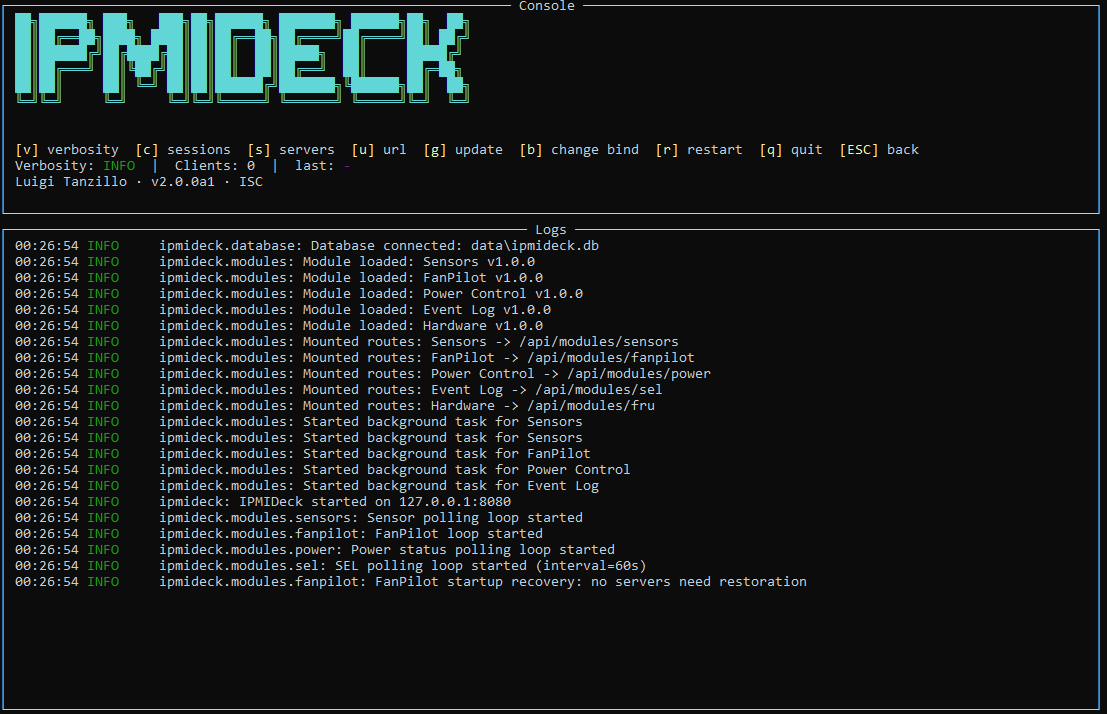
The console right after start: the banner and help bar stay pinned at the top while the log tail scrolls below.
The header
The top of the screen is a fixed header that never scrolls. It stacks, top to bottom:- The ipmideck banner.
- The help bar: every action key and what it does.
- The status line: the live state of the session.
- A compact credits line (author, version, license).
Status line
The status line shows three live fields, separated by|:
- Verbosity: the current log level (
INFO,DEBUG, orWARNING). - Clients: the number of connected dashboard clients right now.
- last: the last action key you pressed, as immediate visual feedback.
Action keys
Every action is one keypress. The help bar lists them all:
Arrow, function, and navigation keys are consumed and ignored, they never collide with an
action or count as a keypress.
v: verbosity
v cycles the runtime log level through a fixed three-step loop:
INFO is the default. DEBUG shows more; WARNING shows less. The change takes effect
immediately for the rest of the session and the status line updates to match.
The verbosity toggle changes the running level only. On the next boot, the level from
your config (or the
IPMIDECK_LOGGING_LEVEL env var) wins again. See Configuration.c: sessions
c opens the Connected sessions sub-view, a read-only table of the dashboard clients
currently attached, with columns:
- IP
- Connected since
- User-Agent
q or ESC to return to the log view.
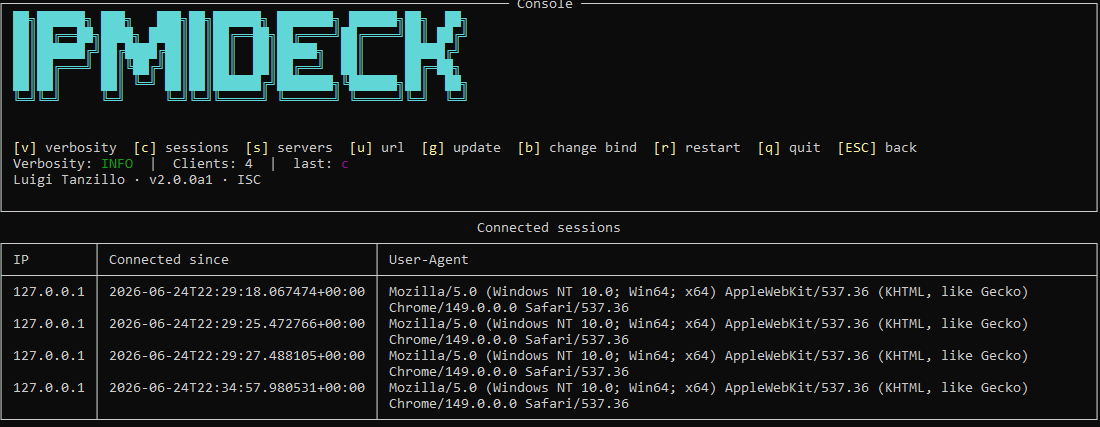
The Connected sessions sub-view (key c), one row per attached dashboard client.
s: servers
s opens the Configured servers sub-view, a read-only table of the BMCs ipmideck is
configured to talk to, with columns:
- Name
- Host
- Status
q or ESC to return to the log view.
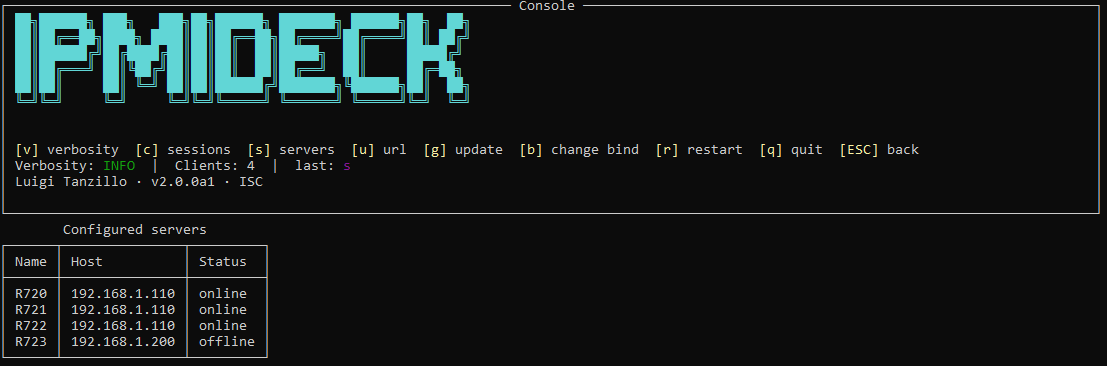
The Configured servers sub-view (key s), listing each BMC and whether it is online.
u: url
u surfaces the dashboard URL (scheme://host:port) in the log body. If the server is
bound to a wildcard address (0.0.0.0, ::, or empty), the URL is rewritten to
127.0.0.1 so it is actually openable in a browser, http://0.0.0.0:3000 is a listen
address, not a navigable one.
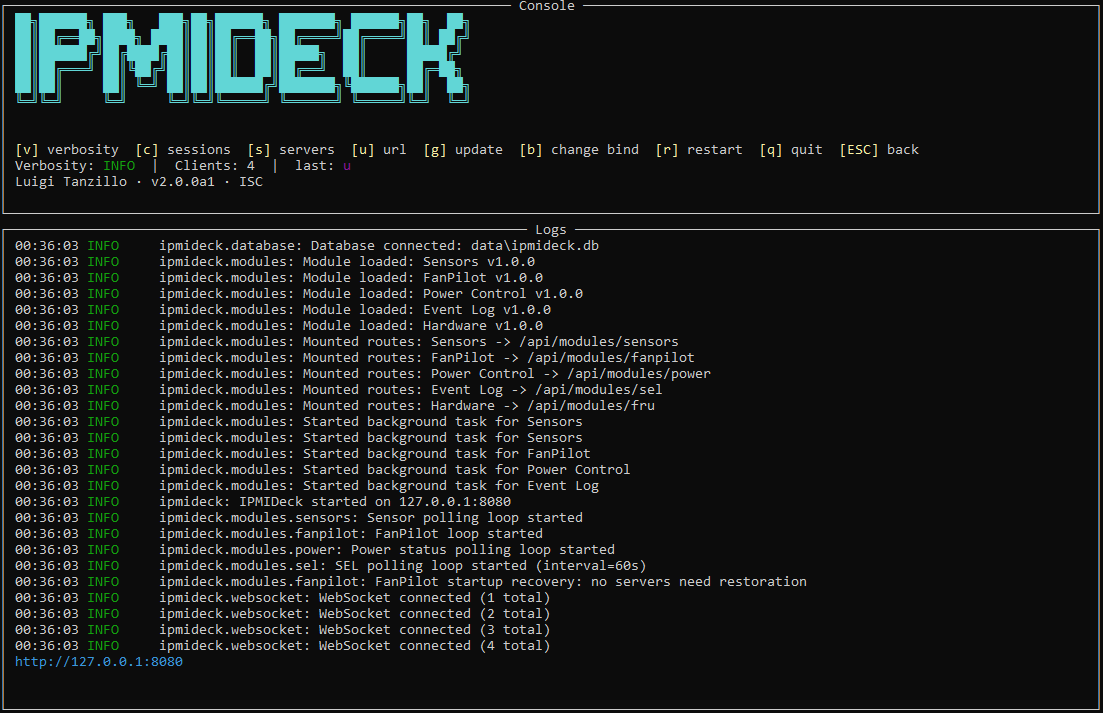
Key u prints the dashboard URL at the bottom of the log, rewritten to a reachable address.
g: update
g prints the local version and a note that the online update check ships with the pip
release. It makes no network call, ipmideck stays offline.
r: restart
r performs a clean in-process restart: ipmideck tears down the console, re-reads
config.yaml, and starts fresh. Use it after a change-bind edit to apply
the new address.
q / ESC: quit and back
- From a sub-view (
sessionsorservers),qandESCboth return you to the log view. - From the log view,
qtriggers a clean exit, the server shuts down gracefully.
b: change-bind
b opens the change-bind editor, an inline host:port prompt that replaces the help bar
while you type. The header shows the current bind as a read-only current: host:port label
and an empty new: field, so the value you type appears immediately and is never confused
with the existing one.

The change-bind editor (key b): the help bar is replaced by the current bind and an empty new host:port prompt.
- Enter: apply the typed
host:port. - ESC: cancel without changing anything.
- Backspace: delete the last character.
- Any printable character, append to the buffer.
host:port with a non-empty host and a port that is an integer in the
range 1–65535. On a valid entry, ipmideck confirms the new bind and reminds you that a restart is
required (press r). On an invalid entry, it reports Invalid host/port and
nothing changes.
Where the console shows up
The interactive console is gated on a real TTY: ipmideck renders it only when both stdin and stdout are interactive terminals. When they are not, it degrades to a banner plus plain scrolling logs and installs no key listener, so nothing busy-spins on a non-TTY. This means the console appears when you run ipmideck directly in a terminal:- Running under Docker: the container launches uvicorn directly and never reaches the
console path; you get plain container logs (
docker logs). - Running under systemd or any service manager where stdout is not a terminal.
- Piping or redirecting stdout (e.g.
ipmideck > server.log): stdout is no longer a TTY.
0.0.0.0:3000; you just get plain logs instead of the live console.
Next steps
- Running ipmideck: start, serve, and the bind-precedence rules.
- The CLI: every subcommand and flag in detail.
- Configuration: set the bind address, verbosity, and polling intervals.
- Installation: install with Docker or pip.